
Интервю на министъра на външните работи Велислава Петрова за предаването "Talking Europe" на френския международен новинарски телевизионен канал FRANCE 24
05 Юни 2026 Изказвания и интервюта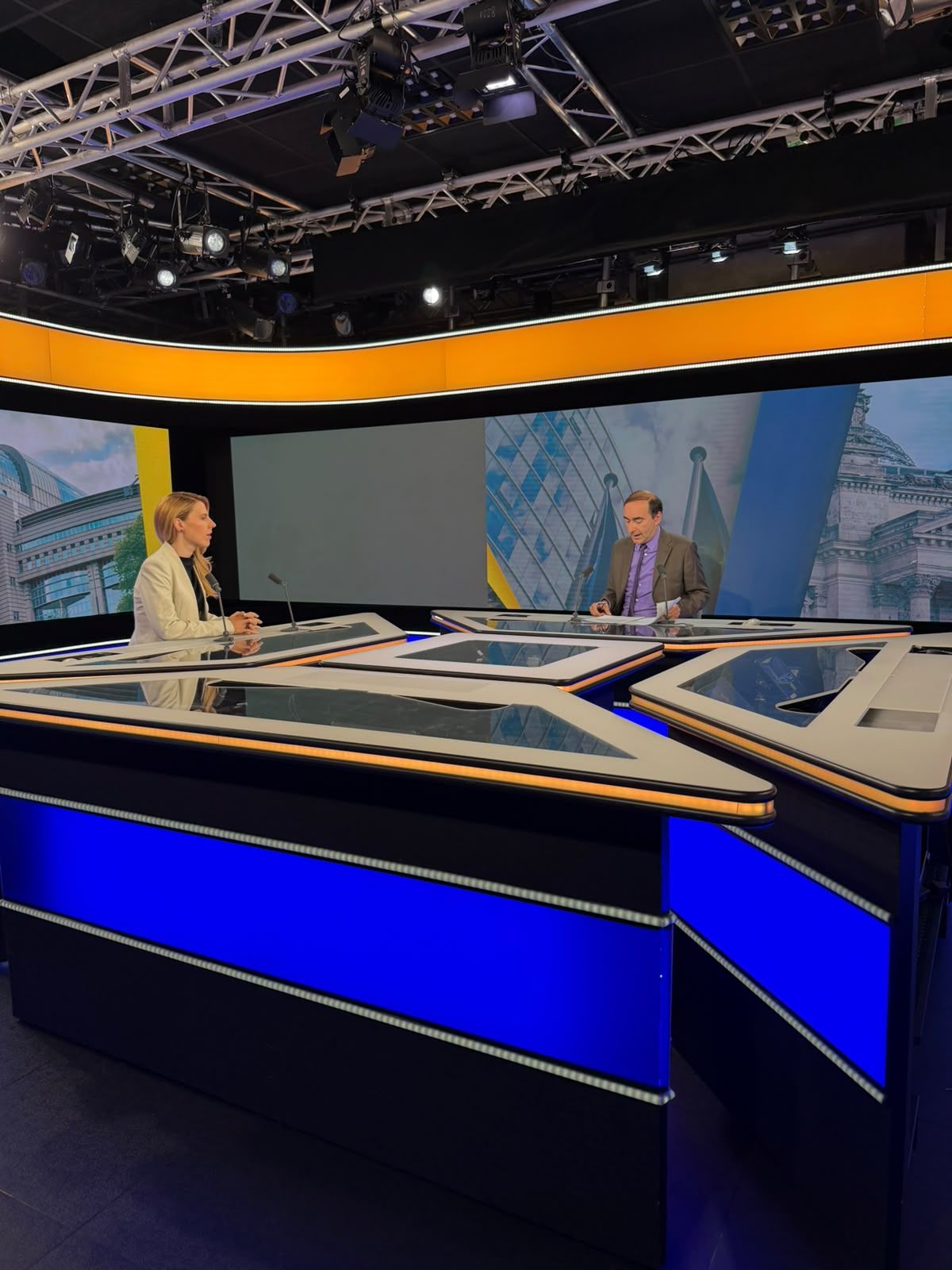
Интервю на министъра на външните работи Велислава Петрова за предаването "Talking Europe" на френския международен новинарски телевизионен канал FRANCE 24 можете да гледате тук.
Публикуваме пълния текст на интервюто на английски език, без редакторска намеса.
Host: Hello, this is Talking Europe. Bulgaria has become notorious for holding elections. In five years, voters went to the polls eight times. But this debilitating crisis finally ended on April the 19th when the Progressive Bulgaria Party won an outright majority. It's led by former President Rumen Radev, now the prime minister. He's pledged to continue on the country's pro-European path. Bulgaria joined the Eurozone in January, and he's also called for pragmatism from the EU towards Russia. That's raised a few eyebrows in other European capitals. Well, today we're very pleased to welcome the new Bulgarian foreign minister in our studios. Velislava Petrova was appointed to this job in early May, but she's no stranger to the foreign ministry nor to European affairs, having been deputy minister of foreign affairs in three consecutive Bulgarian governments. Welcome to the program.
Velislava Petrova: Thank you. Happy to be here.
Host: Let's talk a bit about this pro-European path that I mentioned, because the EU Commission has just unblocked money from the recovery fund for Bulgaria—370 million euros—but it's also holding on to about 3 billion waiting to see what happens with judicial and anti-corruption reforms. So those are very central now to the program, aren't they?
Velislava Petrova: Well, you just said that we've had a majority that we haven't had in more than 20 years. We have a clear mandate from people to deliver on what they expect as the next phase of our European integration. As you said, we closed all different levels with joining Schengen first, then the Eurozone as well. Now people gave us a mandate to fight corruption, to establish the rule of law, and to have transparent working institutions. When it comes to the IRF (Recovery and Resilience Facility), we actually managed to unblock the fourth installment exactly because of the reforms in the judiciary. They were implemented extremely quickly—we were less than four weeks in government and all the legislation was pushed through. So this promise for judicial reform is really already underway and it's happening. The clear direction that we've set for ourselves is to establish working institutions that deliver not just for our citizens but also make us a strong member of the EU and a regional stability factor.
Host: There's a slight dark cloud we might say on this pro-European picture, which is that the EU Commission has proposed opening a disciplinary action against Bulgaria because of its budget deficit. This was obviously not part of the plan when you joined the Eurozone a few months ago. How did this come about and what are you going to do actually to get inside the criteria again?
Velislava Petrova: Well, traditionally Bulgaria has had very good fiscal discipline compared to many other European countries. When you look at our deficit and debt, they are very healthy compared to others. When it comes to the deficit procedure, there's been a lot of push as a result of multiple elections; there were a lot of populist measures that previous governments took that, of course, did not really have a very good impact on our fiscal health. We came into office a month ago, so it's clearly not because of measures that we've established that the deficit suddenly jumped. I think the main point is that this fiscal discipline is something that we've managed to maintain over the years. Right now, it has to be aligned with a clear reform agenda. The previous governments that acted mainly on populism rather than on the true measures that need to maintain a healthy budget will have to pay the price—and in a way they did pay the price during elections but for us, it is a very difficult path ahead. We don't shy away from it and we know that we'll have to set very clear reforms and clear steps forward to maintain within the range.
Host: And those clear steps—for example, the finance minister has spoken about freezing incomes and cutting public spending that could threaten the competitiveness of the Bulgarian economy, which has actually improved in the OECD rankings recently. So that's a bit of a concern.
Velislava Petrova: Yes. Adhering to competitiveness and investing more in turning our economy into a high-skilled, high-tech economy is something that's really high on our agenda. So with any introduction of measures, we really tried to find a balance between those measures that will reduce excessive spending in areas where effectiveness was very low—whether it's administration or in the way specific governance was implemented that allows leakage in the budget or corruption schemes. One of the key areas and the key mandate that our government came into power with was because people wanted us to stop corruption, and we do identify a lot of areas where this was the case. Finding ways to remove that will also help so that any measures are not at the expense of competitiveness but rather at the expense of better use of the resources that we have.
Host: I wanted to ask you about Ukraine because there's obviously been a slightly different tone since your government came into power. For example, Prime Minister Radev recently defended the decision not to join this special tribunal on war crimes. And also, when he was in Berlin, he said it's high time for diplomacy on Ukraine. What does that actually mean? Does that mean the EU should talk directly to Russia now?
Velislava Petrova: Well, first of all, I'll correct you. The joining of the special tribunal was a decision made by the caretaker government, and the only thing we said about it is we would need to know what the financial implications are and what the institutions are that would actually implement the rulings of such a tribunal. It was more about how it would work and how we're going to fund it than a value assessment of it. When it comes to the question about how we handle our discussion with Russia going forward, I think the statement made had nothing different from the way we're thinking right now at the European level and, more importantly, what we hear from Ukraine both from their foreign minister and at the level of the president. We hear the call that Europe needs to step up, meaning Europe cannot allow for discussions about any ceasefire or peace agreement to happen without Europe and without Ukraine. It's just been slightly too long that Europe has been in that position waiting for discussion to happen, whether relying on the US or reliance on an agreement somehow happening in any other means. All we call for is for effective use of all three pillars: military support, economic sanctions, and diplomacy. The third one was missing.
Host: On the diplomacy, though, of course, the EU as usual finds it difficult to agree on one face, one person that should lead those talks. Does Bulgaria have any sort of preferences on that?
Velislava Petrova: We don't have a preference on the person. We have a preference on the unity we need to show. It does not show a very strong image when we are not able to speak between ourselves and demonstrate that this is an "elephant in the room". We need to identify and we should focus on the question of under what terms do we sit at the table? What are the non-negotiables for us and for Ukraine? And how do we conduct those negotiations with what end result in hand? We need to have those discussions internally; it's been a bit too long that we haven't held them. But I am happy and optimistic to see that more and more leaders recognize the importance of it and we see that willingness to have the debate first inside the union and to identify the right format.
Host: So to be clear, there shouldn't be a precondition of a ceasefire before the EU talks to Russia seriously? Because that's kind of the consensus at the moment in Berlin and other European capitals.
Velislava Petrova: Currently, the key hurdle that we see is that nobody has found a way to make Russia sit at the table. So the question is: are we at a good state right now to convince Russia, or is Russia weak enough to be willing to sit at the table? And it seems that looking at the dynamics of the battlefield, there might be the right environment to do that. But we need to be strong and united in the way we sit at the table, and we have to be clear that we shouldn't miss an opportunity.
Host: Bulgaria obviously has a lot of expertise in producing weapons and ammunition; it's got a long tradition of that. How does your government want to shape the whole conversation of European defense and the defense union?
Velislava Petrova: First of all, we absolutely believe that Europe needs to step up its ability to defend itself. Second, we think that the defense ecosystem has really been shifting. We see on the battlefield in Ukraine that weapons or new generations of drones can fight against traditional weapons that are probably 10 to 100 times more expensive. So what we believe is that we really need to think about European investment in defense a bit longer term—about what are going to be the technologies of the future. There, we really think about next-generation drone systems, how we use AI, and more advanced technologies at the battlefield. Because we cannot allow ourselves to miss that opportunity, and we almost have to use the momentum created now and the pressure point that the war creates for us to really leapfrog that step and look into those technologies of the future that also allow for civilian applications—dual-use technologies. It would be worrisome if we only invested in technology that might become obsolete in the next five years because these are huge investments that put huge pressure on our budget both at the European level and nationally. In that regard, we are positioning ourselves as a country that has the tradition of a military industry but is able and willing to transform it into the military industry of the future that will really give us a competitive advantage at the European level.
Host: I wanted to ask you also about EU enlargement and whether you think the powers that be in Brussels are putting enough emphasis on expanding the EU in terms of the Western Balkans? Do you think there's enough political momentum behind taking some more Western Balkans countries into the EU, or has it been pushed to one side because of the emphasis on other things like defense and competitiveness?
Velislava Petrova: The conversation on enlargement I think is picking up pace, mainly because of the necessity to find solutions for Ukraine and Moldova at first, but also on the long journey of the Western Balkans. For us, it is in the interest of the region to have enlargement on top of the agenda. During our Presidency of the Council of EU, we were the country that put enlargement back on the agenda, so we absolutely believe that it should be a topic of high priority. It's one that currently is being subject to a lot of discussion about how we enlarge, for what reason, and whether enlargement contributes to our geopolitical stability, strength, and economic power. One thing that for us is clear is there's a non-negotiable when it comes to the trust that enlargement brings to our citizens. It's important that enlargement does not create a sense of skepticism in some current members but rather the trust that this makes us stronger. Trust requires having the sense of institutions working in those countries. I think transparency, the fundamentals, the rule of law, and working institutions are the areas that are non-negotiables, and then this merit-based approach needs to be the core that we cannot really step away from.
Host: We'll have to leave it there, but thank you so much for being on the program. And that was Velislava Petrova, the Bulgarian foreign minister recently appointed. Glad that she could come to our studios here in Paris. And that's all for this edition of Talking Europe. Glad you could join us.